
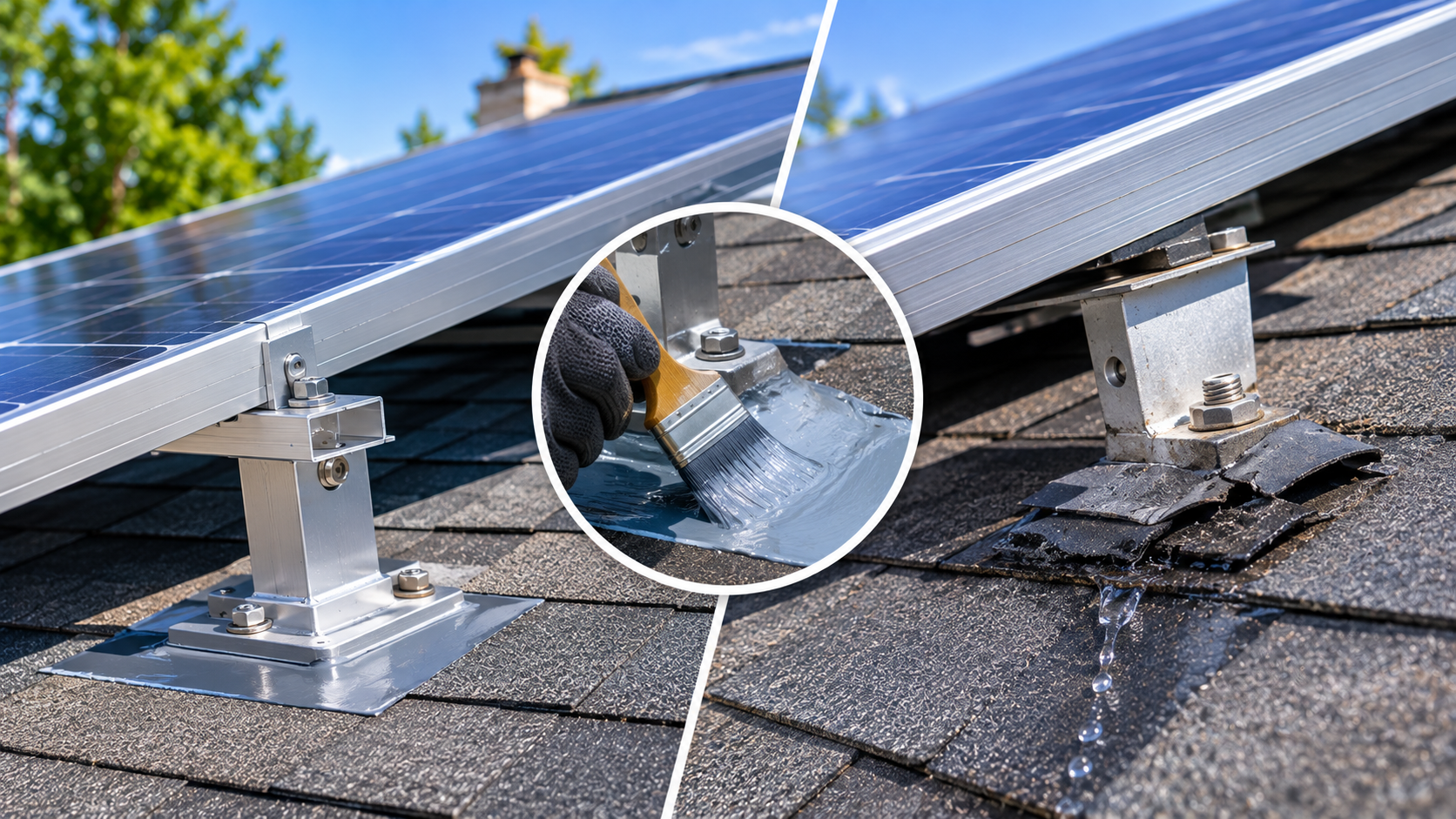
Installing solar panels on a sloped roof involves much more than attaching mounting rails and securing photovoltaic panels. Every mounting point must work with the existing roofing system, provide reliable structural support and protect the roof from water infiltration.
One of the most overlooked parts of a solar installation is the long-term performance of the roof attachments. A mounting system may appear watertight immediately after installation, but poorly detailed penetrations, deteriorating sealants and inadequate maintenance can eventually lead to leaks and costly roof repairs.
For homeowners and commercial property owners in Ontario, coordinating the solar installation with a qualified roofing professional is an important step in protecting the building.
Why roofing expertise matters during solar installation
Solar contractors are responsible for designing and installing solar equipment. However, not every solar installation team has the same level of experience with roofing materials, flashing details and long-term waterproofing.
When solar mounting points are installed without proper coordination with a roofing contractor, important details can be overlooked, including:
- Whether the attachment is compatible with the existing roofing material
- Whether mounting fasteners are secured into the appropriate structural members
- Whether the roof penetration has proper flashing
- Whether the waterproofing materials are compatible with the roof
- Whether the installation affects the existing roof warranty
- Whether the mounting locations can be inspected and maintained
A solar mounting system must do two things successfully: support the solar array and maintain the integrity of the roof.
A strong attachment alone does not guarantee a watertight installation.
The problem with relying only on butyl pads and sealant
Many solar mounting systems use mounting feet with butyl-based adhesive pads or sealing materials. These products can be useful components of a properly designed mounting system, but they should not automatically be treated as a permanent substitute for appropriate flashing and roofing details.
Roof surfaces are exposed to changing temperatures, ultraviolet radiation, rain, snow, ice and movement caused by wind and thermal expansion.
Over time, certain sealing materials can lose adhesion, deteriorate or become less effective. The risk can increase when a mounting foot is installed on an uneven surface, across shingle overlaps or over an improperly prepared area.
Potential warning signs include:
- Separation around the mounting foot
- Cracked or deteriorated sealant
- Lifting or movement at the attachment
- Water staining on the roof deck or interior ceiling
- Moisture around fastener locations
A mounting system that looks properly sealed on installation day may not remain watertight indefinitely if the waterproofing detail is inadequate.
The Building America Solution Center explains that sealants alone can break down under ultraviolet exposure, oxidation, expansion and contraction, and vibration. It identifies proper flashing combined with sealing as an important approach to protecting roof penetrations.
Why proper flashing and polyurethane waterproofing details matter
On a sloped roof, the mounting attachment must be integrated with the roofing system rather than simply placed on top of it.
For many conventional asphalt-shingle installations, this involves a compatible flashing assembly installed in the correct relationship to the surrounding shingles, with the structural fasteners properly secured.
For suitable roofing assemblies, a compatible polyurethane waterproofing coating can provide an additional layer of protection around designated attachment and flashing details.
However, polyurethane coating should not be considered a universal replacement for roof flashing. It must be compatible with the roofing material, mounting system and manufacturer’s installation requirements.
A professional installation should consider:
- Roof and attachment compatibility: Identify the roofing material, age, condition and appropriate mounting system.
- Structural attachment: Confirm the mounting system is designed for the roof structure and applicable wind and snow loads.
- Proper flashing: Use the correct flashing or waterproofing detail for the specific roofing assembly.
- Compatible polyurethane coating: Where approved by the roofing-system manufacturer, apply the specified coating to the designated attachment and flashing areas.
- Quality inspection: Check the finished installation for proper integration, adhesion and drainage.
The objective is to create a durable waterproofing detail that works with the complete roof assembly, not to rely on a small amount of exposed sealant to protect the building indefinitely.
Different mounting requirements for different sloped roofing materials
Not every sloped roof can use the same solar attachment system. The correct solution depends on the roofing material, structural design and mounting manufacturer’s specifications.
Asphalt shingle roofs
<small>Commonly used on residential properties throughout Ontario.</small>
Asphalt-shingle roofs generally use mounting brackets designed to connect to the roof structure. Proper flashing is important to direct water away from the penetration and integrate the attachment with the surrounding shingles.
The attachment should be positioned and installed according to the mounting-system instructions, with particular attention to the roof’s condition and the location of the structural members.
Metal roofs
<small>Standing-seam and exposed-fastener metal roofing systems.</small>
Metal roofs may use different attachment methods depending on the panel profile and roofing system.
Some standing-seam systems allow engineered clamps that attach to the seams without penetrating the metal panels. Other metal roof profiles may require purpose-designed penetrating attachments and compatible flashing.
The attachment must be approved for the specific panel type and structural conditions.
Tile roofs
<small>Clay and concrete tile roofing.</small>
Tile roofs require particular attention because the tile covering and the underlying waterproofing layer serve different functions.
Solar mounting systems must be designed to accommodate the tile profile while maintaining the integrity of the roof underlayment and structural attachment.
Damaged, improperly cut or poorly replaced tiles can create additional water-entry risks.
Cedar roofs
<small>Natural cedar shake and shingle roofing.</small>
Cedar roofing requires careful consideration because of the material’s natural movement, thickness variations and installation details.
Solar attachments must be compatible with the roofing assembly and should not compromise the roof’s ability to shed water.
Before installing solar panels, assess the cedar roof’s age, condition, ventilation and remaining service life. Installing a solar array on a roof approaching the end of its useful life may create additional costs if roof replacement becomes necessary.
The importance of coordinating solar installers and roofing contractors
One of the best ways to reduce roofing-related problems is to involve a roofing professional before the solar mounting system is installed.
A roofing contractor can assess the existing roof, identify vulnerable areas and help coordinate the correct flashing and waterproofing details.
This is particularly important when the solar contractor is responsible for the complete installation but does not specialize in the roofing system itself.
A coordinated installation can help:
- Reduce the risk of poorly sealed roof penetrations
- Protect the existing roofing materials
- Identify repairs that should be completed before solar installation
- Confirm compatibility with roofing manufacturer requirements
- Make future roof inspections and maintenance easier
The goal is not to replace the solar contractor’s expertise. It is to ensure that the solar equipment and roofing system work together.
Why regular solar roof maintenance is essential
Even a professionally installed solar system should be inspected periodically.
Solar panels can make portions of the roof more difficult to access. Mounting points, flashing and drainage areas may also become less visible once the array is installed.
A roof that was in good condition during the original solar installation can develop problems over time due to normal weather exposure, material aging and building movement.
For Ontario properties, seasonal changes make roof maintenance particularly important.
A professional maintenance inspection should consider:
- Visible condition of mounting feet, brackets and flashing
- Deterioration, separation or cracking of exposed sealants and coatings
- Signs of water infiltration around attachment points
- Condition of shingles, tiles or metal roofing around the array
- Roof drainage, valleys and eavestroughs
- Debris accumulation and areas where water may collect
- Evidence of movement or damage to accessible mounting components
Inspection frequency should follow the roofing and solar equipment manufacturers’ requirements and the building’s exposure and condition. A periodic professional roof inspection, with additional checks after significant weather events or when concerns arise, can help identify developing problems before they become major repairs.
Maintenance is especially important when an installation relies on exposed sealants or coatings that require periodic condition checks.
What about Anchor Products U-Anchors?
Anchor Products offers engineered U-Anchor attachment systems for certain commercial rooftop applications. Its solar securement solution connects solar racking to roof-integrated attachment points, with product configurations matched to specific commercial roofing membranes.
For example, the company’s published product information identifies the U2600 Series for modified-bitumen roofing systems and other series for particular single-ply and coating systems.
However, these products should not be confused with conventional residential roof mounts. Anchor Products states that its U-Anchors are designed for commercial low-slope roofs up to 2:12 and that it does not currently offer solutions for conventional shingles, tiles or other residential-style roofing materials.
Always confirm the exact product, roof compatibility, engineering and installation requirements before specifying an attachment system.
Protect your roof investment before and after solar installation
Solar panels are a long-term investment, and the roofing system beneath them is just as important as the equipment installed above.
Poorly detailed mounting points can create water-entry risks. Deteriorating butyl pads, exposed sealants and inadequate flashing can contribute to future roof problems if they are not addressed appropriately.
The best approach is to involve roofing expertise early, use a mounting system designed for the specific roof assembly, follow approved waterproofing details and maintain the roof throughout the life of the solar installation.
At The Cedar Cleaners, we believe that roof maintenance should not stop when solar panels are installed. The roof remains responsible for protecting the entire building, and its condition deserves ongoing attention.
Planning a solar installation or concerned about your existing roof? Contact The Cedar Cleaners to discuss roof inspections, maintenance and roofing concerns in the Greater Toronto and Hamilton Area.
Website: https://thecedarcleaners.com/
Phone: 647-694-0523